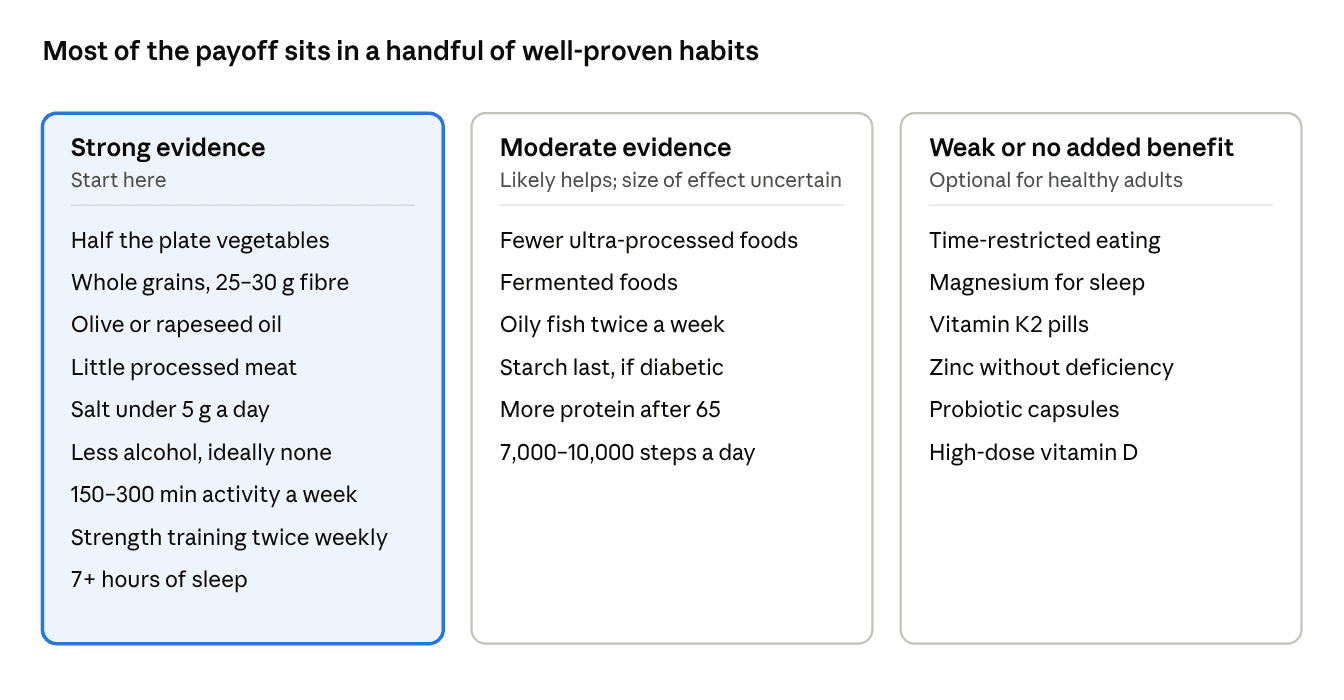
Most of what predicts a long, healthy life is unglamorous: plants on most plates, the right cooking oil, regular movement, enough sleep, and little alcohol. This guide sorts nutrition and lifestyle advice by how strong the evidence actually is, so you can spend your effort where it pays off.
How to read the evidence labels
- Strong: backed by randomised trials or large meta-analyses, and reflected in official guidelines.
- Moderate: consistent observational data or smaller trials; likely true, size of effect uncertain.
- Weak: early, small or mechanistic studies; reasonable to try, not worth worrying about.
This is general information for healthy adults, not medical advice. If you are pregnant, take regular medication or have a chronic condition, check changes with your doctor first.
Editor's note: every study cited here links to its original publication. A few official reference values, marked †, are quoted from European, WHO and UK guidance and are still awaiting a final check against the source documents. They may be refined in a later update.
1. Your plate
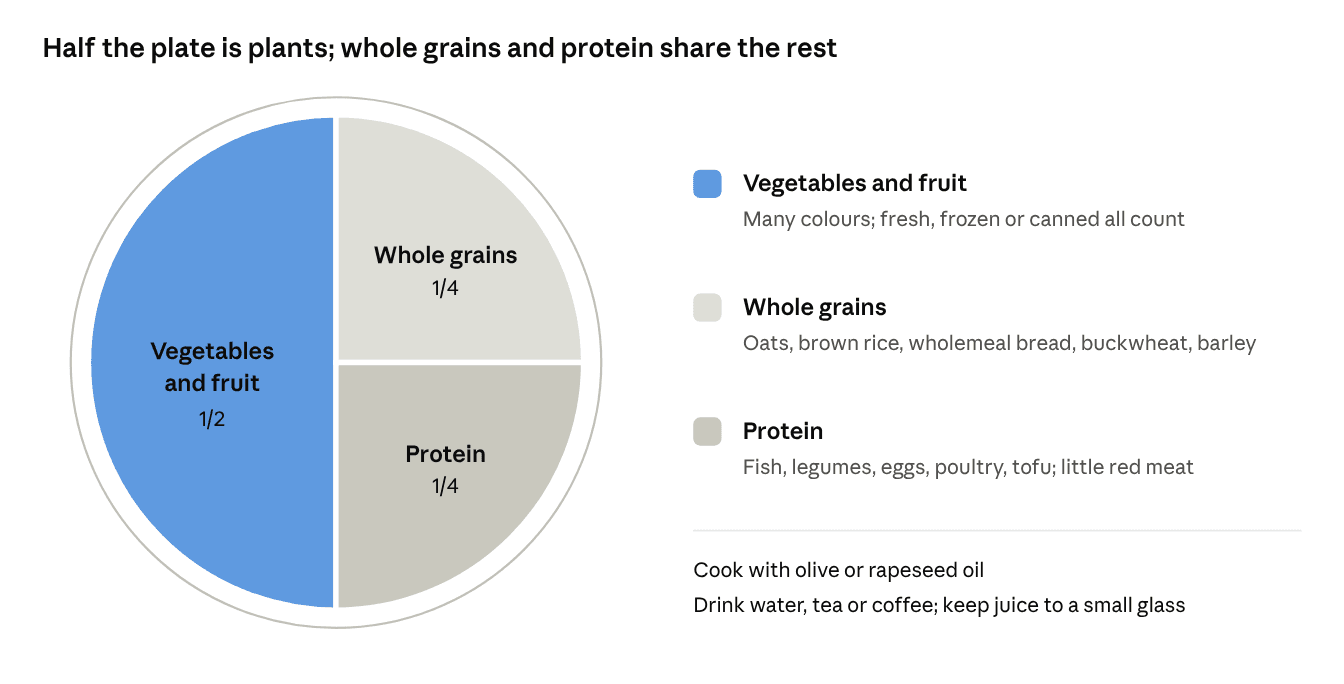
A plate that is half vegetables and fruit, a quarter whole grains and a quarter protein covers most needs without counting anything. This is the model behind Harvard's Healthy Eating Plate. Evidence: strong
Make the grains whole. A Lancet series of meta-analyses (185 cohort studies, 58 trials) found that people eating the most fibre and whole grains had 15–30% lower mortality, heart disease, stroke and type 2 diabetes than those eating the least. The benefit kept rising up to about 25–29 g of fibre a day, a level most adults miss (Reynolds 2019).
- Swap white bread, white rice and plain pasta for wholemeal bread, brown rice, barley, oats, buckwheat or quinoa most of the time.
- Eat legumes (lentils, beans, chickpeas, peas) several times a week. They supply fibre and protein together.
- Frozen and canned vegetables count. Pick ones without added salt or sauce.
Keep ultra-processed food occasional. An umbrella review covering almost 10 million people linked high intake of ultra-processed food to 32 health outcomes. The most convincing links were cardiovascular death, type 2 diabetes, anxiety and common mental disorders (Lane 2024). Evidence: moderate (observational, but consistent).
A useful test: if a product contains ingredients you would never use at home (emulsifiers, flavourings, modified starches, sweeteners), treat it as an occasional food, not a staple.
2. Fats: choose the oil, not the fear
The type of fat matters more than the amount. Replacing saturated fat (butter, ghee, coconut oil, fatty meat) with unsaturated vegetable oils lowers LDL cholesterol and cardiovascular risk. Evidence: strong
- In randomised trials, swapping saturated fat for polyunsaturated vegetable oil cut cardiovascular events by about 30%, similar to a statin (AHA Presidential Advisory, Sacks 2017).
- Coconut oil raised LDL cholesterol by about 10 mg/dL compared with non-tropical vegetable oils across 16 trials (Neelakantan 2020).
- Higher blood levels of linoleic acid, the main omega-6 fat in seed oils, were linked to lower cardiovascular risk in 30 cohort studies of 68,659 people (Marklund 2019). The claim that seed oils are inflammatory or toxic is not supported by human outcome data.
| Use | Best choices | Use sparingly |
|---|---|---|
| Salads, drizzling | Extra virgin olive oil, rapeseed (canola) oil, walnut or flaxseed oil | — |
| Everyday cooking and roasting | Olive oil, rapeseed oil | Butter, ghee, coconut oil |
| Spreads | Soft vegetable-oil spreads, nut butters, avocado | Butter |
| Snacks | Unsalted nuts and seeds, a handful a day | Salted, sugar-coated nuts |
Industrial trans fats are now capped in the EU (2 g per 100 g of fat since 2021†), so modern soft margarines are not the problem they were in the 1990s. Repeatedly reused frying oil and deep-fried fast food are still best kept rare.
3. Protein: enough, and from the right places
Most adults need about 0.8 g of protein per kg of body weight a day; people over 65 do better with 1.0–1.2 g/kg to protect muscle (PROT-AGE 2013). Spreading it across meals, roughly 25–30 g each, is an easy way to get there. Evidence: moderate
Lean on these most of the week: fish (especially oily fish twice a week), legumes, eggs, plain yogurt and other dairy, poultry, tofu and tempeh, nuts and seeds.
Limit red meat and avoid processed meat. The WHO cancer agency classifies processed meat (bacon, ham, salami, sausages) as carcinogenic to humans and red meat as probably carcinogenic, mainly for colorectal cancer (IARC, Bouvard 2015). Harvard's plate gives the same advice. Evidence: strong for processed meat
A practical rule of thumb (not an official limit): no more than about three portions of red meat a week, and processed meat as an exception rather than a habit.
4. Blood sugar: what actually moves the needle
A rise in blood sugar after eating is normal. For healthy people, the quality of carbohydrates and total diet matter far more than chasing a flat glucose curve. The tricks below are real but modest; they matter most if you have prediabetes or type 2 diabetes.
| Strategy | What the studies found | Evidence |
|---|---|---|
| Eat vegetables and protein before starch | Post-meal glucose about 50% lower when carbohydrate came last, in 16 adults with type 2 diabetes (Shukla 2017; first study in 11 patients: Shukla 2015). Not measured as clearly in healthy people. | Moderate (small trials) |
| Cook, chill and reheat rice or potatoes | Chilled and reheated rice had 2.5× more resistant starch and an 18% lower glucose response in 15 adults (Sonia 2015). | Weak to moderate |
| Choose whole grains and legumes over refined starch | Lower risk of type 2 diabetes at higher fibre and whole-grain intake (Reynolds 2019). | Strong |
| Time-restricted eating (eating window) | No better than ordinary calorie reduction for weight, fat or metabolic markers over 12 months in 139 adults with obesity (Liu 2022). | Strong (no extra benefit) |
Snacks are not the enemy. If you are genuinely hungry between meals, a snack built on protein or fibre (yogurt, fruit with nuts, hummus with vegetables) is a sensible choice. What matters is what you snack on and how often you eat without being hungry.
5. Drinks
Water, coffee and tea are the best everyday drinks. Sugary drinks and alcohol are the two worth cutting back hardest.
Water. European reference values put total water needs at about 2.0 L a day for women and 2.5 L for men†, from all drinks and food combined; food supplies roughly a fifth. Drink to thirst, more in heat or during exercise. Pale-yellow urine is a reasonable everyday check.
Salt. There is no need to add salt to water. Adults already eat about 11 g of salt a day on average, more than twice the WHO limit of 5 g (WHO). Most of it comes from bread, cheese, processed meat, ready meals and sauces. Evidence: strong
Coffee. Up to 3–4 cups a day is associated with lower overall mortality and lower risk of several chronic diseases, across 201 meta-analyses (Poole 2017). Pregnant women should keep caffeine lower. Two timing points are well supported:
- Stop caffeine at least 6 hours before bed; 400 mg taken 6 hours before bedtime still cut sleep by about an hour (Drake 2013).
- Coffee and tea with a meal sharply reduce iron absorption from plant foods (−39% for coffee, −64% for tea), but not when drunk an hour before eating (Morck 1983). This matters most for vegetarians and people prone to low iron.
Sugary and diet drinks. Fruit juice and sodas deliver sugar without the fibre of whole fruit; keep juice to a small glass at most. Sweetened “diet” drinks are better than sugary ones, but the WHO (2023) advises against relying on sweeteners for weight control.†
Alcohol. The idea that moderate drinking protects health has not held up. A 2023 meta-analysis of 107 studies and 4.8 million people found no protective effect from low intake once study biases were corrected. Mortality rose significantly from 25 g a day in women and 45 g a day in men (about 2 and 3.5 standard drinks) (Zhao 2023). Alcohol also helps you fall asleep, then suppresses REM sleep and fragments the second half of the night (Ebrahim 2013). Less is better; none is best.
6. Supplements: for specific needs, not for everyone
A healthy adult eating a varied diet needs few supplements. The large trials have mostly been disappointing for people who were not deficient. Supplements earn their place for particular groups, at sensible doses.
| Supplement | Who may benefit | Sensible dose | Watch out for | Evidence |
|---|---|---|---|---|
| Vitamin D | People with little sun (northern winters, covered skin, housebound), adults over 75, people with dark skin in low-sun countries | 600–800 IU/day (800 IU after 70); higher only if prescribed | Upper safe limit 4,000 IU/day.† In healthy adults 19–74, the Endocrine Society advises against doses above reference intakes and against routine blood testing (Demay 2024). 2,000 IU/day did not reduce cancer or heart events in 25,871 adults (VITAL, Manson 2019). | Strong (no benefit beyond need) |
| Vitamin B12 | Vegans, many vegetarians, people over 50, long-term metformin or acid-reducing drug users | Per product label or doctor's advice | Essential for vegans: plants provide none. | Strong |
| Folic acid | Anyone who could become pregnant | 400 µg/day, before conception and in early pregnancy | Standard prenatal advice. | Strong |
| Creatine monohydrate | Adults doing strength training; older adults aiming to keep muscle | 3–5 g/day | Safe in healthy people; check with a doctor if you have kidney disease (ISSN, Kreider 2017). Brain benefits are still preliminary. | Strong for muscle |
| Omega-3 (EPA + DHA) | People who eat no oily fish | Prefer 2 portions of oily fish a week; if supplementing, up to 1 g/day | Doses above 1 g/day raised atrial fibrillation risk by 49% across 7 trials of 81,210 people (Gencer 2021). Talk to a doctor if on blood thinners. | Moderate |
| Magnesium | People with low intake (few whole grains, nuts, greens) or on some diuretics | Food first; supplements at most 250 mg/day† | Higher supplemental doses cause diarrhoea. Evidence for better sleep is weak. | Weak to moderate |
| Zinc | Only with a confirmed deficiency | Short courses, as advised | Adults need 8–11 mg/day from all sources†; long-term high doses can cause copper deficiency. | Weak for routine use |
| Vitamin K2 | Not recommended for routine use | — | A 2-year trial (180 heart patients, 360 µg/day) found a possible effect on some plaque calcification; clinical value unknown (VitaK-CAC 2026). Interacts with warfarin. | Weak |
Test when there is a reason. Blood tests make sense with symptoms, a restrictive diet, pregnancy, certain medications or a doctor's indication, not as an annual routine for everyone.
7. Sleep and light
Adults need at least 7 hours of sleep a night on a regular basis, according to the American Academy of Sleep Medicine and Sleep Research Society (Watson 2015). Short sleep makes hunger, mood and blood-sugar control harder to manage the next day. Evidence: strong
The body clock is set mainly by light. An international expert consensus gives concrete targets (Brown 2022):
- Daytime: bright light, ideally outdoors. Even a cloudy day outside is far brighter than an office.
- Last 3 hours before bed: dim, warm lighting.
- During sleep: as dark as possible.
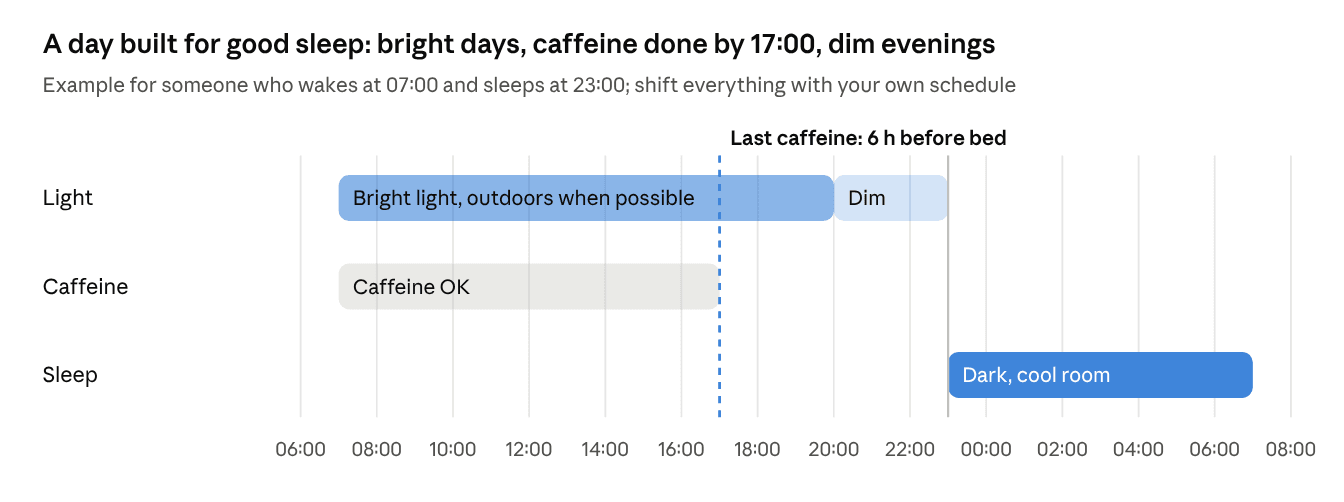
Other habits with reasonable support: a consistent wake-up time (weekends included), a cool and quiet bedroom, caffeine stopped at least 6 hours before bed, and no alcohol as a sleep aid.
8. Movement
The WHO target for adults is 150–300 minutes a week of moderate activity (or 75–150 minutes of vigorous activity), plus muscle-strengthening on at least 2 days (Bull 2020). Any amount above zero helps; more helps more. Evidence: strong
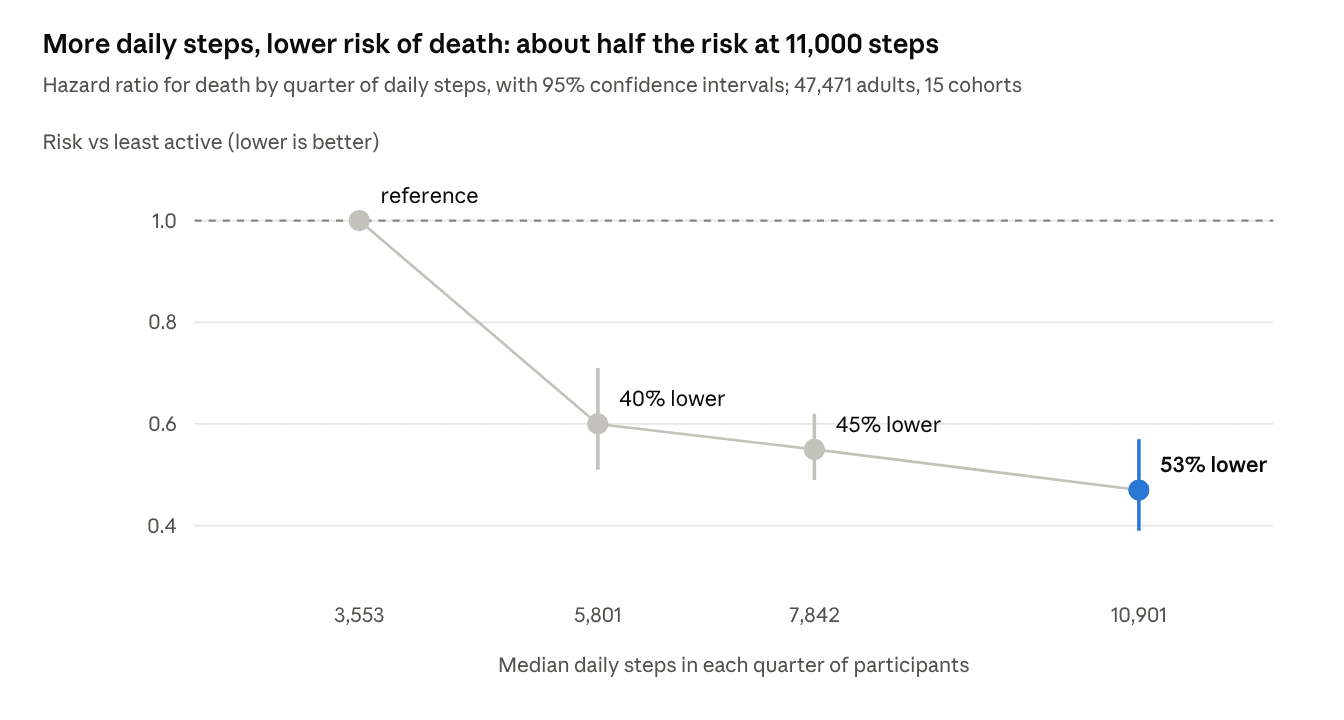
Most of the gain comes from the first few thousand extra steps; the benefit keeps growing, but more slowly, after that.
| Goal | What the evidence says |
|---|---|
| Daily steps | Mortality risk fell steadily up to about 6,000–8,000 steps/day in adults 60+ and 8,000–10,000 in younger adults (15 cohorts, 47,471 people; Paluch 2022). |
| Offsetting desk work | 60–75 minutes a day of moderate activity removed the extra mortality risk linked to long sitting, in over 1 million people (Ekelund 2016). |
| Fitness | In 122,007 adults given a treadmill test, the fittest had an 80% lower risk of death than the least fit, with no upper limit of benefit (Mandsager 2018). It is one of the strongest predictors of longevity, alongside not smoking and blood pressure. |
| Strength | Twice a week, using bodyweight, bands or weights, all major muscle groups. Muscle protects mobility and independence with age. |
Start with walking, add a couple of short strength sessions, then include some activity that makes you breathe hard (brisk uphill walks, cycling, swimming, running).
9. Gut health
The gut microbiome responds quickly to what you eat, and the two levers with the best evidence are fibre and fermented foods. Capsule probiotics matter much less than marketing suggests.
- Fibre feeds gut bacteria. Aim for 25–30 g a day from a wide variety of plants: vegetables, fruit, whole grains, legumes, nuts and seeds. Variety matters as much as quantity.
- Fermented foods add diversity. In a 17-week randomised study, healthy adults who ate several servings a day of yogurt, kefir, kimchi, sauerkraut and similar foods increased microbiome diversity and lowered several inflammatory markers (Wastyk 2021). The study was small (18 people per group), so treat it as promising. Evidence: moderate
- Probiotic capsules are rarely needed. The American Gastroenterological Association recommends them only for specific situations, such as preventing certain infections in preterm babies or during some antibiotic treatments, and not for most digestive complaints (AGA, Su 2020).
- Go easy on NSAIDs. Frequent ibuprofen or similar painkillers can irritate and damage the stomach and gut lining; use the lowest effective dose.
See a doctor if you have lasting changes in bowel habits, blood in stools, unexplained weight loss, persistent abdominal pain or bloating, or difficulty swallowing. These need proper investigation rather than diet experiments.
10. Shopping and labels
The nutrition table on the back of a pack tells you more than any claim on the front. Words like “natural”, “fit” or “protein” say nothing about overall quality.
UK front-of-pack labelling gives handy reference points per 100 g of food† (UK guidance):
| Per 100 g | Low | High |
|---|---|---|
| Sugars | 5 g or less | more than 22.5 g |
| Saturated fat | 1.5 g or less | more than 5 g |
| Salt | 0.3 g or less | more than 1.5 g |
Quick checks in the shop
- Ingredients are listed by weight, so the first two or three tell you what you are mostly buying.
- For bread and cereals, look for “wholemeal” or “wholegrain” as the first ingredient and at least 6 g of fibre per 100 g†.
- For yogurt, plain is the default; add your own fruit.
- Compare similar products per 100 g, not per serving, since serving sizes vary.
A basic weekly basket: seasonal and frozen vegetables, fruit, oats, wholemeal bread, brown rice or other whole grains, dried or canned legumes, eggs, plain yogurt, oily fish (fresh, frozen or canned), olive and rapeseed oil, unsalted nuts and seeds, herbs and spices to replace some of the salt.
11. A 12-month plan
Change sticks better when it is added gradually. Take one habit a month, keep it, then add the next; reorder freely to suit your life.
- Walk every day, building towards 7,000–10,000 steps.
- Fill half of lunch and dinner plates with vegetables.
- Switch your main grains to wholegrain versions.
- Cook with olive or rapeseed oil instead of butter or coconut oil.
- Eat legumes at least three times a week.
- Have oily fish twice a week, or plan an alternative if you don't eat fish.
- Add two short strength sessions a week.
- Set a fixed wake-up time and stop caffeine 6 hours before bed.
- Spend time outdoors in daylight every morning.
- Cut alcohol to fewer days and smaller amounts, or stop.
- Replace processed meat and salty snacks with nuts, yogurt or fruit.
- Review supplements with your doctor based on your diet, age and life stage.
Sources
All links checked on 3 October 2026.
Guidelines and position statements
- Harvard T.H. Chan School of Public Health. Healthy Eating Plate.
- World Health Organization. Sodium reduction fact sheet.
- Bull FC et al. WHO 2020 guidelines on physical activity and sedentary behaviour. Br J Sports Med 2020.
- Sacks FM et al. Dietary Fats and Cardiovascular Disease: AHA Presidential Advisory. Circulation 2017.
- Demay MB et al. Vitamin D for the Prevention of Disease: Endocrine Society Clinical Practice Guideline. J Clin Endocrinol Metab 2024.
- Watson NF et al. Recommended Amount of Sleep for a Healthy Adult (AASM/SRS). J Clin Sleep Med 2015.
- Brown TM et al. Recommendations for daytime, evening, and nighttime indoor light exposure. PLoS Biol 2022.
- Bauer J et al. Optimal dietary protein intake in older people (PROT-AGE). J Am Med Dir Assoc 2013.
- Kreider RB et al. ISSN position stand: creatine supplementation. J Int Soc Sports Nutr 2017.
- Su GL et al. AGA Clinical Practice Guidelines on Probiotics. Gastroenterology 2020.
- Bouvard V et al. Carcinogenicity of consumption of red and processed meat (IARC). Lancet Oncol 2015.
- UK Department of Health. Front of pack nutrition labelling guidance.
Meta-analyses and reviews
- Reynolds A et al. Carbohydrate quality and human health. Lancet 2019.
- Lane MM et al. Ultra-processed food exposure and adverse health outcomes. BMJ 2024.
- Neelakantan N et al. Coconut oil consumption and cardiovascular risk factors. Circulation 2020.
- Marklund M et al. Biomarkers of dietary omega-6 fatty acids and incident CVD. Circulation 2019.
- Zhao J et al. Daily alcohol intake and risk of all-cause mortality. JAMA Netw Open 2023.
- Poole R et al. Coffee consumption and health: umbrella review. BMJ 2017.
- Ebrahim IO et al. Alcohol and sleep I: effects on normal sleep. Alcohol Clin Exp Res 2013.
- Gencer B et al. Marine omega-3 supplementation and atrial fibrillation. Circulation 2021.
- Ekelund U et al. Physical activity, sitting time and mortality. Lancet 2016.
- Paluch AE et al. Daily steps and all-cause mortality. Lancet Public Health 2022.
Trials and cohort studies
- Manson JE et al. Vitamin D supplements and prevention of cancer and CVD (VITAL). NEJM 2019.
- Menaquinone-7 supplementation and coronary artery calcification (VitaK-CAC). JAMA Cardiol 2026.
- Liu D et al. Calorie restriction with or without time-restricted eating. NEJM 2022.
- Shukla AP et al. Food order and postprandial glucose. Diabetes Care 2015.
- Shukla AP et al. Carbohydrate-last meal pattern in type 2 diabetes. BMJ Open Diabetes Res Care 2017.
- Sonia S et al. Cooling cooked white rice: resistant starch and glycemic response. Asia Pac J Clin Nutr 2015.
- Wastyk HC et al. Gut-microbiota-targeted diets modulate human immune status. Cell 2021.
- Drake C et al. Caffeine taken 0, 3 or 6 hours before bed. J Clin Sleep Med 2013.
- Morck TA et al. Inhibition of food iron absorption by coffee. Am J Clin Nutr 1983.
- Mandsager K et al. Cardiorespiratory fitness and long-term mortality. JAMA Netw Open 2018.
† Reference values awaiting a final check against the original documents: EFSA 2010 reference values for water; EFSA upper limits for vitamin D, magnesium and zinc; EU Regulation 2019/649 on trans fats; WHO 2023 guideline on non-sugar sweeteners; the UK “high” thresholds in the label table; the EU “high fibre” claim threshold of 6 g/100 g.